TEKROMANCY.COM
THE CRUCIBLE
OF HACKERS
The History of Capture The Flag, Red vs. Blue Teaming Doctrine, and Open-Source Cyber Range Frameworks.
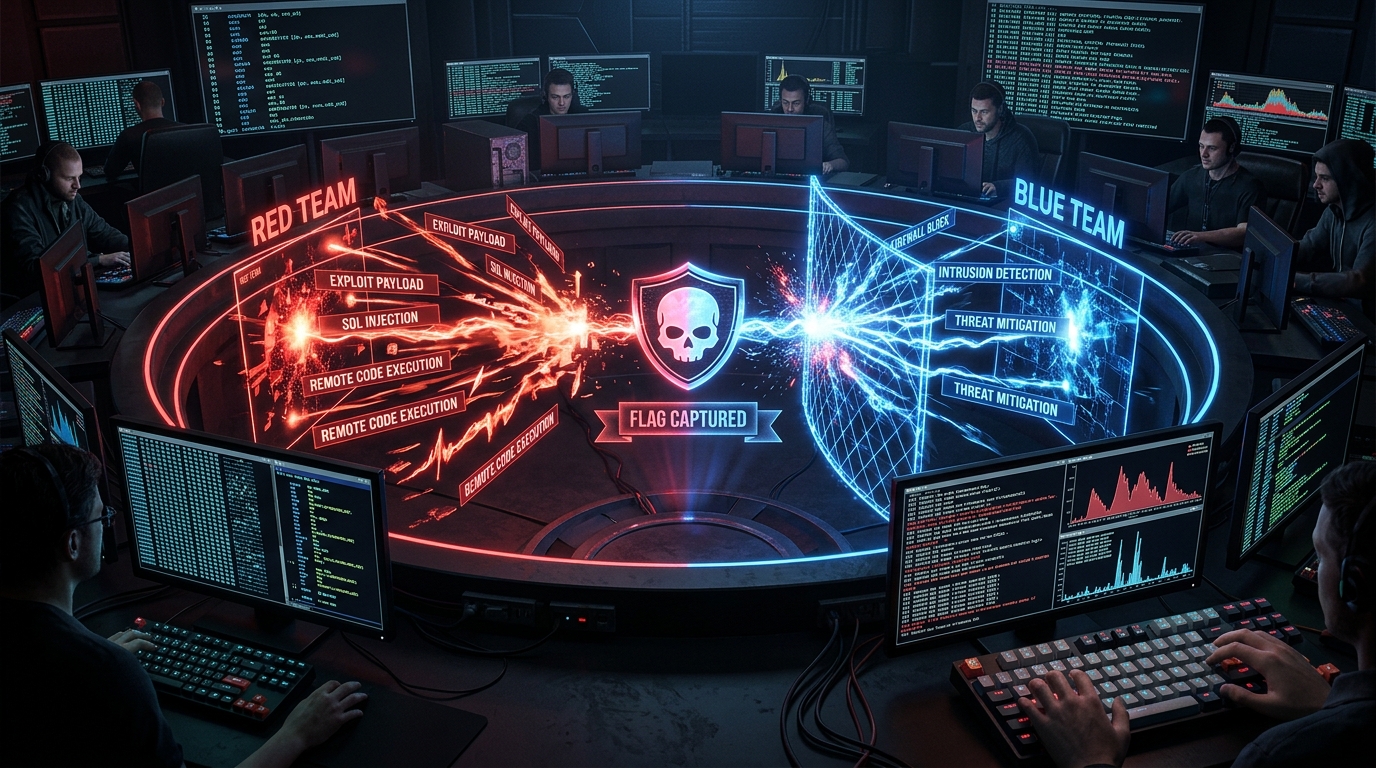
RAND Corporation & Warsaw Pact Emulation
During the 1960s and 70s, the US Department of Defense and think tanks like RAND formalized the concept of Red Teaming: deploying an independent faction tasked with thinking, planning, and striking exactly like the Soviet Union against Western defenses.
The 1980s US Navy Red Cell
Headed by Commander Richard Marcinko, Red Cell tested security at nuclear installations, submarines, and airbases using ruthless physical tradecraft:
- Picking mechanical perimeter locks & forging clearance badges
- Smuggling mock explosives into sensitive command facilities
- Kidnapping base commanders to prove physical perimeter failure
Strict Rules of Engagement
The Department of Defense tasked its Red Team to launch a simulated cyber assault with one strict limitation: Use exclusively publicly available, commercial-off-the-shelf software and freeware scripts downloaded from underground hacker sites.
The Catastrophic Findings
- Compromised critical US military command-and-control (C2) grids in days
- Gained root access to regional electrical utilities and telecom switches
- Proved public internet infrastructure could induce catastrophic military paralysis
# EXERCISE ELIGIBLE RECEIVER 97 - RED CELL TRACE
[!] TARGET: US Pacific Command / Defense Switching Network
[+] SCANNING: commercial port scanner / war dialer
[+] FOUND: Unpatched sendmail & Solaris RPC services
[>] EXPLOIT: underground hacker script (phrack_c.c)
[***] SYSTEM PWNED: ROOT SHELL ESTABLISHED (uid=0)
========================================================
RESULT: Command & Control grid completely penetrated.
CONCLUSION: Commercial networks represent an existential vector.
Eligible Receiver 97 served as the historic catalyst that institutionalized permanent military cyber commands and mandated enterprise Blue Team SIEM monitoring.
Adversary Simulation
Operates like an active threat actor executing real-world TTPs:
- Initial access & phishing tradecraft
- Custom implant development & C2
- Kerberoasting, AD abuse, privilege escalation
- Stealthy lateral movement & data staging
Defensive Hardening
Defends enterprise assets through telemetry, detection, and mitigation:
- Endpoint Detection & Response (EDR)
- SIEM ingestion, correlation rules & alerts
- Kernel eBPF anomaly tracking
- Memory forensics & incident containment
The Feedback Loop
Collaborative synthesis between Red and Blue forces:
- Tests MITRE ATT&CK techniques side-by-side
- Verifies whether SIEM/EDR alarms actually fire
- Calibrates log ingestion and closes blind spots
- Measures detection coverage with data
The Wild West of Wargaming
At DEF CON 4 in 1996, organizers taped RJ45 twisted-pair and coaxial cables across hotel casino conference carpets. Unmanaged 10BASE-T hubs connected Linux and BSD towers into a free-for-all shared broadcast domain.
Offense vs. Defense in 1996
- The Attack: Promiscuous packet sniffing over unencrypted hubs, ARP spoofing, broadcast storming, telnet sniffing.
- The Defense: Emergency bash loops killing incoming telnet sessions, quick hex patches to
/bin/login, iptables predecessor ipfw.
#!/bin/bash
# DEF CON 4 Emergency Survival Script (1996)
while true; do
  # Kill all unauthorized telnet logins from rivals
  ps aux | grep in.telnetd | grep -v root | awk '{print $2}' | xargs kill -9
  # Check if our secret flag file was modified
  md5sum /root/flag.txt >> /tmp/flag_integrity.log
  # Flush ARP table to survive ARP poisoning
  arp -d -a
  sleep 1
done
From these chaotic, cable-strewn beginnings emerged the formal rule sets that would define professional competitive hacking for the next 30 years.
Find the Zero-Day
Every team receives identical server images running proprietary custom services written in C, C++, or x86 assembly with deliberate bugs:
- Stack & heap buffer overflows
- Format string vulnerabilities
- Race conditions & flawed crypto
- Automate exploit payload submission
Binary Patching
Teams must patch their own vulnerabilities in real time:
- Binary diffing & hex-editing ELF binaries
- Hooking functions with LD_PRELOAD
- Writing network filters with eBPF/iptables
- Closing the exploit before rivals reverse it
SLA Availability
You cannot simply pull the network plug or crash the service:
- Central scoring engine verifies functionality
- Submits legitimate test traffic every tick
- If your patch breaks legitimate behavior: SLA penalty
- Must steal flags while keeping services green
THE ATTACK-DEFENSE SCORE FORMULA
Points = (Flags Captured from Rivals) + (Flags Defended) - (Service SLA Downtime Penalties)
K2 & DEF CON Staff
Pioneered network wargames on physical cables. Established the basic concepts of flags, scoring, and time limits in chaotic conference environments.
Goolsbey & DDL
Introduced automated scoring servers, structured challenge formats, and the transition from casual games to rigorously monitored international tournaments.
Kenshoto
Revolutionized Attack-Defense with custom network topologies, proprietary scoring daemons, and hyper-complex multi-threaded binary challenges.
LegitBS
Legitimate Business Syndicate introduced custom processor architectures (DEFCON x86, cLEMENCy) running on bare QEMU hypervisors to defeat existing disassemblers.
Order of the Overflow
Pushed into microservices, browser zero-days, multi-architecture pwn, and hardware hacking, setting a new benchmark for competitive difficulty.
Nautilus Institute
Current organizers: satellite hacking, live cyber-physical systems, automotive CAN bus, and integrating autonomous AI reasoning into qualification events.
Jeopardy
Static challenge board categorized by technical discipline. Points scale dynamically with solver count.
- Categories: Web, Pwn (Binary Exploitation), Reverse Engineering, Cryptography, Forensics
- Skills: Deep technical problem solving, code auditing, solo or distributed team workflows
- Examples: CTFtime global circuit, picoCTF, Google CTF, DEF CON Quals
Attack-Defense
Live combat between rival teams defending identical networked server infrastructure over dedicated VPNs.
- Categories: 0-Day Discovery, Live Binary Patching, Network Packet Sniffing, SLA Defending
- Skills: Fast-paced script automation, memory corruption mitigation, binary diffing
- Examples: DEF CON Finals, FAUST CTF, HITCON, iCTF, Enowars
King of the Hill (KotH)
Multiple teams battle for persistent root access on shared target machines, maintaining their foothold while evicting rivals.
- Categories: Privilege Escalation, Linux Process Hunting, Backdoor Eviction, Rootkits
- Skills: High-stress Linux administration, stealth persistence, adversarial containment
- Examples: DEF CON OpenCTF, HackTheBox KotH, University cyber ranges
CTFd / CTFd
Python / FlaskThe undisputed king of Jeopardy CTFs. Powers thousands of worldwide competitions. Plugins for Discord/Slack, dynamic scoring, dockerized deployment.
google / kctf
Go / nsjailGoogle's enterprise infrastructure for running dangerous pwnable and web challenges isolated inside cryptographically secure nsjail containers on Kubernetes.
RootTheBox
Tornado / WSGamified cyber-combat and KotH platform with corporate espionage mechanics: earn in-game cash to purchase black-market malware and DDoS attacks against rivals.
FAUST CTF Engine
Python / WireGuardDeveloped by FAU Germany for massive international Attack-Defense games. Full game controller, automated SLA flag checkers, and WireGuard/BGP network routing.
MITRE CALDERA
Python / ATT&CKAutomates adversary behavioral profiles aligned to MITRE ATT&CK. Deploys lightweight agents across Windows/Linux to test whether your Blue Team detections actually fire.
GOAD
Ansible / TerraformGame of Active Directory: Multi-domain vulnerable enterprise Active Directory forest. Ideal for practicing Kerberoasting, ACL abuse, and AD CS certificate escalations.
| Repository | Format | Stack | Deployment | Maintenance | Best Use Case |
|---|---|---|---|---|---|
| CTFd | Jeopardy | Flask / Redis / MariaDB | Docker Compose | High | Corporate events, school/university CTFs, fast setup |
| RootTheBox | KotH / Game | Tornado / WebSockets | Docker / Bare Metal | Moderate | Gamified espionage, interactive team workshops |
| kctf (Google) | Container Sandbox | Go / nsjail / Bash | Kubernetes (GKE) | High | Zero-trust binary pwn & RCE container isolation |
| Enowars | Attack-Defense | C# / .NET / Redis | Docker Engine | High | Multi-team tournament engine with sub-second SLA |
| MITRE CALDERA | Adversary Emulation | Python / ATT&CK API | Cross-Platform | High | Testing SIEM/EDR detection rules against ATT&CK TTPs |
| GOAD | Active Directory Lab | Ansible / Terraform / PS | Proxmox / ESXi / Cloud | Very High | Real-world enterprise AD exploitation and lateral defense |
# Production 3-Tier CTFd Cluster
version: '3.8'
services:
  ctfd:
    build: .
    ports:
      - "8000:8000"
    environment:
      - DATABASE_URL=mysql+pymysql://ctfd:ctfd@db/ctfd
      - REDIS_URL=redis://cache:6379
    depends_on: [db, cache]

  db:
    image: mariadb:10.11
    environment:
      - MYSQL_PASSWORD=ctfd

  cache:
    image: redis:7-alpine
# 1. Clone the repository
$ git clone https://github.com/CTFd/CTFd.git
$ cd CTFd

# 2. Launch production containers in background
$ docker compose up -d
[+] Running 3/3
 ✔ Network ctfd_default  Created
 ✔ Container ctfd-db-1   Started
 ✔ Container ctfd-ctfd-1 Started

# 3. Verify health status
$ docker compose ps
NAME         STATUS         PORTS
ctfd-ctfd-1  Up 20 seconds  0.0.0.0:8000->8000/tcp
ctfd-db-1    Up 20 seconds  3306/tcp
ctfd-cache-1 Up 20 seconds  6379/tcp
➔ Ready for Battle: Navigate to http://localhost:8000 to run the setup wizard, configure team registration, and upload your initial challenge flags.
DARPA AI Cyber Challenge (AIxCC)
At DEF CON 32, DARPA and leading AI labs unveiled autonomous cyber reasoning systems. LLM-powered autonomous agents can now:
- Decompile, audit, and discover novel zero-day vulnerabilities in minutes
- Synthesize non-breaking binary patches and verify SLA compliance
- Compete against human offensive teams in real-time Attack-Defense
Kernel-Level Observability with eBPF
Traditional user-space logging is blind to stealthy rootkits. Modern Blue Teams deploy extended Berkeley Packet Filters (eBPF):
- Monitors system calls and socket lifecycles inside the Linux kernel
- Intercepts malicious privilege escalations before execution completes
- Real-time telemetry without modifying application source code

CONCLUSION: THE CRUCIBLE
1. Compliance Fails
Checklists build complacency. Only continuous adversarial testing reveals real organizational exposure.
2. Break to Build
Understanding how memory corruption, C2, and kernel hooks work makes you an incomparably better architect.
3. Open-Source Ranges
From CTFd to GOAD and CALDERA, the tools to build world-class training ranges are freely available to all.
NEVER INVADE RUSSIA IN THE WINTER."
Supply Line Depletion
The Grande Armée marched 680,000 soldiers into Russia. Scorched-earth tactics, zero local supply, and -35°C blizzard winds turned retreat into catastrophe. Only ~27,000 returned.
Hardware Thermal Lockup
Synthetic motor oil solidified into lard at -40°C. Tank tracks froze solid to the mud. Bolt-action rifles had to be thawed over campfires. General Winter maintained 100% defensive SLA.
The Siberian Server
Don't launch aggressive zero-days against Siberian bulletproof hosting in January. The sysadmins are fueled by vodka and pure spite, your packets will freeze in the permafrost, and General Winter does not honor TCP RST flags!
❄️ THE RED/BLUE TEAM PRINCIPLE OF COMBAT
Offensive hubris is always humbled by defensive environmental reality. In CTFs and in production: know your battleground, respect the defender's terrain, protect your supply lines, and never attack into sub-zero conditions.
3D CYBERSPACE CONSTELLATION
THE COMPLETE HISTORY & TAXONOMY OF CAPTURE THE FLAG